

A single visit rarely explains a decision. Someone finds an article through search, returns directly a week later, views pricing, disappears for ten days, and only writes on chat during the third visit. If you look only at the last visit, you will see direct traffic and conclude that content does not work. The full journey tells a very different story.
Why a single visit is misleading
Reports show sessions by default because they are easier to count. The problem is that customers do not think in sessions. To them, it is one matter spread across several attempts, often on two devices and with a weekend in between. Treating every visit as a separate event leads to three common mistakes.
- False direct trafficA return after several days usually has no source, even though the first visit had a specific one.
- Undervalued contentAn article rarely ends with an immediate inquiry, but it often begins the entire journey.
- Overvalued contact pageIt is the final step, not the reason someone made a decision.
- A short visit treated as failureA 20-second visit can be a deliberate return to find the phone number.
This guide concerns connecting one person's multiple visits. If you are looking for a method to analyze behavior within a page—what people click, where they pause, and where they abandon a form—start with our guide to analyzing user behavior on a website. Here we take a broader, longer view.
What makes a useful visit history
Not every record supports a conclusion. A history becomes useful when you can answer five questions for each visit: where did the person come from, where did they land, what did they do, how did it end, and did they make contact at all?
Scroll the table sideways to see all columns.
| Element | What it tells you | Common interpretation error |
|---|---|---|
| Entry source | Where that visit came from | Treating the last source as the reason for the decision |
| Landing page | What attracted attention this time | Judging content solely by the last visit |
| Exit page | Where interest ends | Treating every exit as a problem |
| Active time | How long attention actually lasted | Mistaking an open tab for reading |
| Events and contact | What happened and whether there was a conversation | Overlooking matters handled by phone |
The most valuable element is the last one: connecting visits with actual contact. Visits without contact let you form hypotheses, but only a question asked on chat or in a callback request turns a guess into information. We explain how to select material for this kind of verification in our article on analyzing session recordings.
- Day 1
Arrival from search on a guide, with 4 minutes of active time
- Day 6
Direct return, pricing and implementation page
- Day 6
Opening chat and asking about launch time
- Day 9
Arrival from an email link, contact form
Attribution without overinterpretation
Attribution is a convention, not the truth about reality. Every model assigns credit according to an adopted rule, not according to what actually persuaded the person. That is why you should know which rule you use and remember its limitations during every budget conversation.
- Tag campaigns consistently with UTM parameters; without them, the history fragments into direct traffic.
- Record the first and last source separately—they are two different pieces of information, not competing answers.
- Do not compare channels with different roles in the journey using one conversion rate.
- Check how many visits have no recorded source at all before drawing conclusions about channels.
- Treat a conversation or callback request as a full conversion, not a side event.
- Before changing the budget, verify your conclusions over a period longer than one week.
Attribution shows where the customer was, not why they decided. You will usually learn the reason from the question they asked.
An additional privacy note: visit history is data about a specific person and is subject to the same rules as other website data. Its scope, retention, and access deserve deliberate decisions—the checklist in our article on live chat and GDPR will help.
Paid traffic is a special case because it is easy to blame the campaign for a problem on the landing page. We describe how to check what happens after the click in our article on why paid traffic does not convert.
Two directions for reading the history
You can read visit history in two directions, and each answers a different question. The choice depends on whether you want to understand success or find the place where something breaks down.
- Work backward from contact.Take the ten most recent inquiries and trace their visits backward. Look for a recurring entry pattern.
- List the common elements.The same landing page, the same number of visits before contact, or the same gap in days.
- Work forward from entry.Choose one important source and see what happens during those people's subsequent visits.
- Find the stopping point.The stage after which the story ends is a better candidate for improvement than the page with the lowest conversion rate.
- Form one hypothesis.Write it as a falsifiable sentence, for example by naming missing information about implementation time.
- Verify it in conversation.Questions asked on chat are the cheapest way to test a hypothesis about missing information.
Working backward usually produces faster results because you begin with cases that already have business value. Working forward is better when you are assessing a new channel or website section and do not yet have enough inquiries.
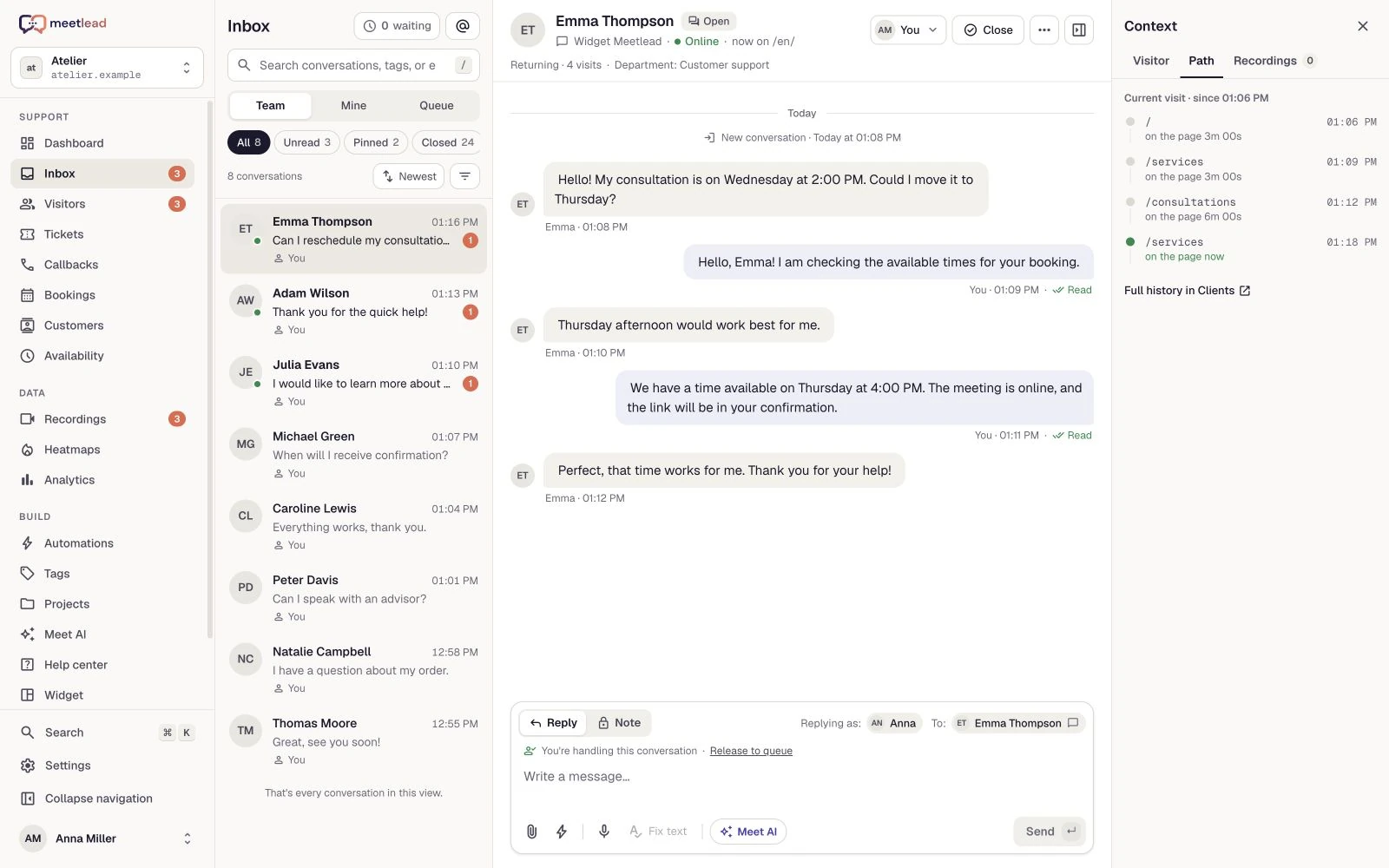
Sessions, entry sources, recordings, and conversations collected on the customer profile. See behavior analytics.
The most practical use of this direction is when a customer has received an offer and gone silent. We explain what to check before sending a reminder in our article on following up after an offer.
Scroll the preview sideways or enlarge it to see the details.
What this data cannot tell you
An honest journey analysis begins by knowing what is missing. The gaps below are not tool defects; they are natural properties of online measurement.
Scroll the table sideways to see all columns.
| Gap | Where it comes from | How to handle it |
|---|---|---|
| Device change | A phone and laptop usually create two separate histories | Connect them only after identification, such as during contact |
| No recorded source | Browser settings and missing campaign parameters | Report the share of visits without a source alongside the results |
| Decisions made off-site | A phone call, referral, or meeting | Ask directly at first contact |
| Data retention | Older visits are deleted according to policy | Match the analysis period to the actual data window |
| Several people from one company | The journey is split across several profiles | In B2B, treat the company rather than the visit as the unit |
In Meetlead, visit history covers only the active website, and sessions with no recorded source are marked as unattributed instead of being assigned an invented origin. It looks less impressive in a report but is far safer for decision-making.
If 30% of visits have no recorded source, no channel ranking is definitive. Report that share alongside the conclusion, not separately in a footnote.
The same data can produce one highly practical number: how much time passes between the first visit and the inquiry. We explain the method in our article on customer decision time.
A routine that keeps it under control
- Once a month, review the ten latest inquiries backward through their visit histories.
- List observations and hypotheses in separate columns without mixing fact and interpretation.
- Check the share of visits without a recorded source and note it beside your conclusions.
- Compare the result with the previous month before declaring a trend.
- Choose one change and define how you will know it worked.
- Record the questions customers ask most often—they are material for content and your FAQ.
The last point closes the loop. A recurring question in conversations is the best clue to what the journey lacks and, at the same time, a ready-made topic to add to the website. If you want to turn such observations into an organized list of improvements, use the process from our website conversion audit.
A special case of this analysis is assessing how content contributes to inquiries. We explain how to calculate that without relying on circulating statistics in our article on the results of a company blog.