
A website callback lets visitors request a phone call without calling the company themselves. They provide their number and—depending on the configuration—a topic and preferred time. The company receives the request and calls back according to an agreed process. It is a simple mechanism, but its effectiveness depends more on how the team is organized than on the form itself.
A callback does not always mean an automatic connection
Two different models share the same name. In the first, a phone system automatically connects the customer to an available agent. In the second, a widget records the request and an employee calls back manually—either straight away or at a selected time. Before implementation, state clearly which model you offer, because they create entirely different expectations.
Meetlead uses the second model. The widget form can collect a name, phone number, topic, date and time. Once saved, the request is confirmed, enters the queue and can have a pending or completed status. The product does not promise to establish an automatic connection within a given number of seconds.
The message in the widget must match what will happen after the customer submits their number. If the team will call within a selected time window, do not describe the service as an instant connection.
A callback is one of several channels. If a customer wants to resolve a quick question without a phone call, a well-implemented website live chat may be a better fit.
Talk now or at a time chosen by the customer?
The “as soon as possible” option works when the team can genuinely pick up the request quickly. A selected time is safer for longer sales processes, consultations and companies with fixed business hours. It also gives customers control: they do not have to wait by the phone without knowing when someone will call.
Scroll the table sideways to see all columns.
| Option | Best suited to | What the company needs |
|---|---|---|
| As soon as possible | A simple sales question and an available agent | Reliable coverage and an honestly stated expected wait |
| Selected date and time | A consultation, demo, quote or complex offering | An up-to-date schedule and someone responsible for the appointment |
| Out-of-hours message | Contact in the evening, at the weekend or during a break | Confirmation of receipt and clear information about the next step |
In Meetlead, availability can be defined with a weekly schedule. The widget can use it to display available call slots. A schedule still needs oversight, however: holidays, time off and team meetings should be accounted for before customers see a time. If you work on site, use the same windows in which you return missed calls; we describe that routine in our guide to missed calls from customers.
How should you design a callback form?
The form should collect the minimum needed for the conversation. A phone number is essential; a name helps start the call, and a short topic helps route the request to the right person. A date and time make sense only if the company can honor them. Every additional field should have a specific purpose.
- PromiseSay whether you will call back now, during business hours or at a selected time.
- Data collectedCollect only the information needed to fulfill the request.
- ConfirmationOnce saved, show that the request arrived and explain what happens next.
- AlternativeLet customers return to chat or another channel if they change their mind.
The consent and information about processing the phone number must reflect the company's actual purpose and process. Do not copy a random formula from another website. The team should also know where the request is stored and who can access it.
Server-calculated slots, the team's schedule and a request with a case number. Explore the contact channels.
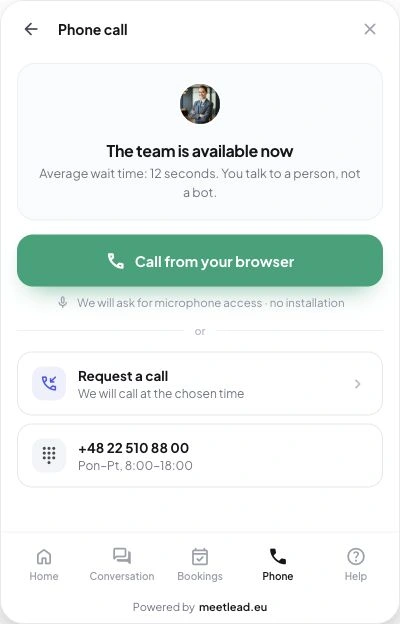
A direct call needs different preparation from a callback request. Check browser voice calls, operator availability and microphone permission.
From submitting a number to completing the call
A good callback process has a visible state at every stage. An email containing a phone number is easy to miss, assign to two people or leave unanswered. A request queue separates new requests from completed ones and preserves the topic of the call.
- The customer submits a request.The widget validates the required data, saves the request and only then displays confirmation.
- The team is notified.A new item appears in the queue; if no one is available, the owner can receive an email notification.
- One person takes ownership.The team decides who will call back and how to avoid two calls to the same person.
- The call takes place at the agreed time.The agent knows the topic and can prepare the right information before calling.
- The request is closed.A “completed” status means the request was handled, not merely that someone opened the record.
It is worth recording a simple definition of “handled” for the queue. Dialing the number does not close the case if the customer did not answer or asked to reschedule. Even if the product stores only the main statuses, the team can distinguish between a first attempt, a callback to retry and a completed conversation. This keeps the report from mixing attempted calls with actual conversations and tells the next person what to do.
A callback queue works best as part of a single service process, rather than a separate list of calls to make. A case number, status and thread owner organize it just like any other request—we explain this in our guide to customer service ticketing systems.
If contact is triggered by a rule based on time, page or customer behavior, set frequency limits. Our guide to live chat and widget automation shows how to design these scenarios without intrusive messages.
The number of people who need to cover the phones during a given period follows from the distribution of requests, not intuition. We explain how to calculate it in our article on customer service staffing.
When does a callback help, and when does it get in the way?
Callbacks suit offerings that cannot be explained well in a single sentence: implementations, specialist services, quotes, financing, real estate or products that require tailoring. A phone call is also a good next step when a chat has become lengthy or requires gathering several pieces of information.
Do not open the form for everyone as soon as they arrive, however. Someone who has only just read the headline has no reason to leave a number yet. A visit to the pricing page, a return to a service page or deliberately opening the contact menu may be a better signal. Activity alone does not prove intent—the broader process is covered in our guide to analyzing user behavior.
The choice of channel also depends on the team. If the company does not want or cannot handle phone calls, a callback becomes a promise it cannot keep. It helps to compare live chat, chatbots and callbacks by question type and staff availability.
If a service has a fixed duration and does not require a quote, consider letting customers book a time directly instead of requesting a call. Our guide to online booking systems explains when this works and which settings determine its effectiveness.
Once launched, review the topics of the calls as well. If customers repeatedly ask for the same information, part of the problem may be on the website rather than in the contact channel. A callback should support important decisions, not replace a missing explanation of the offering's basic terms.
A visible opportunity to talk also signals credibility, regardless of how many customers use it. We have collected the other elements that influence trust in our article on building trust on your website.
This decision looks different for service businesses than for online stores because the phone is the default channel. Our guide to contact channels for service businesses explains how to choose the right mix.
Checklist before launching callbacks
- The widget clearly says whether the connection is manual or automatic.
- Customers see genuine business hours or available call times.
- The form collects only the data needed to make contact.
- The confirmation explains when and how the company will respond.
- Every new request has one owner.
- The team distinguishes between pending and completed statuses.
- There is a procedure for failed calls and rescheduling.
- After launch, you track the number of requests, handling time and recurring topics—without attributing intentions the customer did not express.
It does not come from simply collecting a number. It comes from giving customers control over when the conversation happens and bringing every request to an unambiguous conclusion.
If the call is followed by a proposal, decide in advance what to check before sending a reminder. We cover this in our article on following up after a proposal.